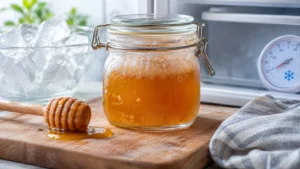
Can you freeze honey? Yes, and it’s safe. It won’t turn into a solid block, though. Honey just gets thick and slow in the freezer, then flows again once you thaw it gently.
That matters if you keep Sidr honey at home in Singapore. Sidr honey is made by bees that forage on the Sidr tree, also called the Lote tree. Maybe you bought a big jar and want it to last. Or your honey turned grainy, and you’re wondering what went wrong. Here’s what cold really does to honey’s texture and quality.
Can You Freeze Honey?
Yes, you can freeze honey. It’s safe, and it won’t spoil in the freezer. But most households don’t need to, because a sealed jar in the cupboard already lasts a long time.
People usually freeze honey for three reasons. Some have spare jars they won’t open for months. Others want to slow the darkening and flavour loss that can happen over the years. And a few just want fewer crystals. So freezing is a storage choice, not a must-do. It works best when you have extra honey and a little freezer space.
Does Honey Freeze Solid?
No. The freezing point of honey is around -20°C (-4°F), and most home freezers are set to around -18°C (0°F). So honey in your freezer turns very thick and slow, not hard like ice.
Water freezes at 0°C. Honey doesn’t follow that rule. Ripe honey has less than 20% water, and most of the rest is sugar. That sugar blocks ice from forming the way it does in a glass of water. Go much colder, below about -42°C (-44°F), and honey can turn hard and glassy. Home freezers don’t come close to that. Ever tilted a frozen honey jar? It still moves, just very slowly.
What Happens If You Freeze Honey?
Frozen honey gets thicker, slower, and sometimes a little grainy. Its taste and safety don’t change if you thaw it gently. Texture is what you’ll notice. Picture cold molasses. It’s not hard, but it won’t pour. You may not be able to drizzle or squeeze it until it warms up.
Flavour and colour hold up well in the cold. On a shelf, honey can darken over the years and lose some of its punch. Freezing can slow that down.
Grainy bits are where it depends. Crystals are tiny sugar crystals that form when glucose separates from the water in honey. Raw or unfiltered honey has particles, like pollen, that crystals form around. So it grains more easily. Steady cold also helps, while moving a jar in and out of the freezer doesn’t. And grainy honey isn’t spoiled. It’s crystallized honey, and it’s still fine to eat.
Key Differences Between Honey Crystallization and Freezing
Freezing is honey thickening in deep cold, around -20°C. Crystallization is glucose separating from the water in honey and forming tiny sugar crystals, usually at cooler temperatures around 10–18°C (50–64°F). They can look alike in a jar. But they’re different things.
|
Freezing |
Crystallization |
| Temperature |
Around -20°C (-4°F) |
Often 10–18°C (50–64°F) |
| What happens |
Honey turns thick and semi-solid |
Glucose forms small sugar crystals |
| Texture |
Thick, hard to pour |
Grainy or spreadable |
| Can you reverse it? |
Yes, thaw it slowly |
Yes, warm it gently |
| Harms quality? |
No, if thawed gently |
No |
Here’s what trips people up. A freezer isn’t the crystal zone. Fridge-cold honey often crystallizes faster, so the fridge is a poor spot for it. Want smooth honey? Keep it at room temperature, or freeze it and leave it alone.
How to Freeze Honey the Right Way
Use a clean glass jar with a tight lid, leave a small gap at the top, and keep the freezer temperature steady. That’s the whole method. Honey barely expands, but the gap is cheap insurance.
- Pick the right jar. Glass won’t soak up freezer smells. The jar your honey came in works too, as long as the lid seals tight.
- Leave a little headspace. That’s the empty gap at the top of the jar. Honey doesn’t expand much, but a bit of room helps.
- Wipe the outside. Sticky drips collect frost and make a mess later.
- Bag it. A sealed freezer bag catches leaks and keeps smells out.
- Freeze it and leave it alone. Steady cold works best, so park the jar at the back, away from the door.
Only need a spoonful at a time? Pour honey into an ice cube tray, freeze it, then move the cubes into a bag. Take out one cube when you want it.
How to Thaw Frozen Honey Safely
Thaw frozen honey slowly. Leave the jar at room temperature, or stand it in a bowl of warm water for a few hours. Skip boiling water and the microwave, because too much heat can dull honey’s flavour.
Keep the water gentle, about 40°C or lower. Boiling water can also crack a glass jar, especially one straight from the freezer. Stir once the honey runs again. And don’t rush it. A large jar can take hours, and that’s fine. If your thawed honey looks grainy, the same warm bath works. Crystals melt back with gentle heat. Just keep the heat low.
Tips for Maintaining Honey’s Taste and Texture
Open honey with a clean, dry spoon, seal it after every use, and keep it away from sun and heat. Those three habits protect taste and texture better than any trick.
- Use a dry spoon. Water in the jar can lead to fermentation.
- Close the lid every time. In humid Singapore, damp air can slip in whenever the lid is off.
- Keep it out of the sun and away from the stove. Heat can dull the flavour.
- Freeze in portions you’ll finish. Thaw what you need. Freezing and thawing the same honey again and again isn’t a good habit.
- Write the date on it. You’ll know what’s been in the freezer, and for how long.
Should You Freeze Honey in Singapore?
Usually, no. In Singapore, a tightly sealed jar in a kitchen cupboard is enough for everyday honey. Freeze spare jars, or honey you won’t open for months.
Warm weather isn’t the problem, because honey handles warmth fine. Humid air is the bigger worry. Moisture can make honey ferment if it gets into the jar. So the lid matters more than the temperature.
| Where |
Best for |
Watch out for |
| Kitchen cupboard |
The jar you’re using now |
Sun and stove heat |
| Freezer |
Spare jars and long-term storage |
Slow thaw, steady cold |
| Fridge |
Not recommended |
Can speed up crystals |
The cupboard is best for the jar you’re using. The freezer is best for spares. If you buy a big jar like the 900g Sidr honey, freezing part of it is one way to make it last.
Can You Freeze Sidr Honey and Honey Straws?
Sidr honey is still honey, so the same freezing rules apply. Use a glass jar, a tight lid, and steady cold. For honey straws and minis, there’s no tested freezing guide here, so check the pack or ask Little Honey before you freeze them.
Sidr honey has a thick texture to begin with. In the freezer, it may turn extra slow, so give a jar of 300g Kashmiri Sidr honey plenty of time to thaw.
Want small portions without freezing at all? The honey minis come in small packs, so you can open one at a time. Not sure about a product? Message Little Honey on +65 86512712.
Little Honey is a Singapore honey seller at 807A Chai Chee Rd. It sells Yemeni and Kashmiri Sidr honey, honey straws, minis, sachets and gift sets, and delivers across Singapore.
Final Thoughts
So, can you freeze honey? Yes. It’s safe; it won’t freeze solid, and a slow thaw brings it back to normal. For daily use, a sealed jar in the cupboard is usually enough. Freeze spares and long-term stock, and skip the fridge.
Explore the Sidr Honey Collection at Little Honey Straws, a Singapore honey seller featuring Yemeni Sidr honey, Kashmiri Sidr honey, honey straws, minis and gift sets. We deliver across Singapore. Visit our collection to see the available options. You can also read our story or reach us through our Contact Us page if you need help choosing the right honey for your home.
FAQs
- Can you freeze honey?
Yes, you can freeze honey. It’s safe and won’t spoil in the freezer. It won’t freeze solid, though. It just gets very thick, then flows again after a slow thaw. Use a glass jar with a tight lid.
- At what temperature does honey freeze?
Honey freezes at around -20°C (-4°F). That’s lower than most home freezers, which sit near -18°C (0°F). So honey in your freezer turns very thick and slow, not hard.
- Does freezing ruin honey?
No. Freezing doesn’t ruin honey. Its flavour and colour hold up, and it’s safe to eat after thawing. The main change is texture. It gets thick and may turn a little grainy if crystals form.
- Is frozen honey safe to eat?
Yes. Frozen honey is safe to eat once thawed. Freezing changes texture, not safety. Thaw it slowly in a warm room or a warm water bath, and skip boiling water and the microwave.
- How do you thaw frozen honey?
Leave the jar at room temperature, or set it in a bowl of warm water for a few hours. Keep the water at about 40°C or lower. Boiling water can crack glass and dull the flavour.
- Should honey be kept in the fridge?
No. A fridge can make honey crystallize faster and turn grainy. Keep it in a sealed jar in a cool cupboard instead. For long-term storage, the freezer works better than the fridge.