Ask most people what honey is good for, and they’ll say sore throats or a soothing drink before bed. But could honey have a place in your daily stress routine, too?
It’s an interesting question. Researchers have started exploring the relationship between honey, brain health, and stress responses. Some early animal studies have reported encouraging findings, although human research remains limited. So, what does science actually tell us about honey for anxiety and stress? Let’s look at the evidence, understand the role of cortisol, and find simple ways to enjoy honey as part of a balanced daily routine.
Early research, mostly in animals, suggests honey may support a calmer mood. Human evidence is limited, and honey hasn’t been proven to lower cortisol. It can be a pleasant part of a calming routine, but it isn’t a treatment for anxiety.
Cortisol is your body’s main stress hormone. Picture running late for a flight. Your heart speeds up, your mind sharpens, and cortisol is part of the reason why. In short bursts, that’s helpful. But prolonged stress can disrupt the body’s normal cortisol rhythm, which may affect sleep, mood, and other aspects of health.
So when a food gets credit for “lowering cortisol,” it’s a big claim. It needs solid proof. Let’s see what honey has.
Most of the available research comes from animal studies, with some encouraging findings.
In a 2014 study, stressed female rats given Tualang honey, a Malaysian variety, showed less anxiety-like behaviour than stressed rats without it. A 2009 study in Physiology & Behavior followed rats on different diets for up to a year. The honey-fed rats showed less anxiety-like behaviour than rats fed sucrose, and they did better on a memory task. In 2020, researchers gave stingless bee honey to rats with metabolic problems. Behaviour tests pointed to less anxiety-like behaviour and better memory.
Rats aren’t people, though. Their doses and diets are nothing like ours. These results can’t tell us what a spoonful in your evening tea does.
What about humans? A 2023 review in Frontiers in Aging Neuroscience looked at 34 studies on honey and brain health in humans, rats, and mice. A 2022 review in the Rawal Medical Journal reported benefits for stress, depression, and anxiety symptoms. But a review is only as strong as the studies inside it, and we couldn’t find large, well-run human trials on honey and anxiety.
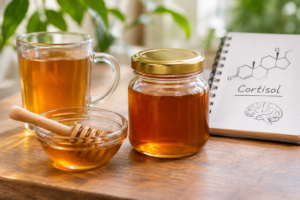
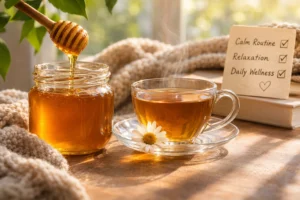
Alt text: Jar of golden honey with a wooden honey dipper, a cup of warm tea, and cortisol research notes in the background.
Not much, and the findings are mixed. So far, honey hasn’t been proven to lower cortisol in humans.
A small 2020 study involving 30 women with mild stress divided participants into three groups of ten: a control group, a honey group, and a honey-with-propolis group. Cortisol levels decreased in both honey groups, but the changes were not statistically significant.
A 2025 trial published in the Croatian Medical Journal examined 55 patients preparing for gallbladder surgery. Those given a honey solution had higher cortisol and interleukin-6, a marker of inflammation, at several measurement points than those given a standard carbohydrate drink. The honey group also showed improved gastric motility. However, this study examined surgical stress, not everyday anxiety.
Animal research offers a similarly mixed picture. A 2021 study in female mice found that ginger honey did not significantly reduce cortisol levels. The takeaway? Current evidence doesn’t establish that honey lowers cortisol in people. More human research is needed before making that claim.
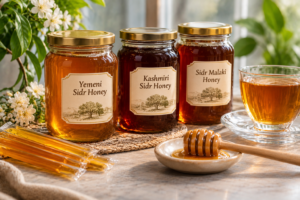
Alt text: Yemeni Sidr, Kashmiri Sidr, and Sidr Malaki honey jars with honey straws and a cup of honey tea.
If you’re looking for honey for anxiety and stress to enjoy during a busy day, Yemeni Sidr Honey is a lovely everyday choice. Its rich taste and versatility make it easy to enjoy in warm tea, spread over toast, or drizzled on your morning breakfast.
Little Honey offers four options:
| Honey | Best for |
| Yemeni Sidr Honey | Everyday use, tea, and breakfast |
| Kashmiri Sidr Honey | Daily use and enjoyment at home |
| Sidr Malaki Honey | A premium honey option for special occasions or gifting |
| Honey Straws | Work, travel, and convenient single servings |
For an everyday jar, Yemeni Sidr is my first recommendation. If you prefer smaller, convenient portions while working or travelling, Honey Straws are a practical alternative.
Want to compare the two Sidr varieties? Read our guide to Yemeni vs. Kashmiri Sidr Honey, or see how honey straws compare with honey jars.
Any calming effect may come more from the routine than from the honey itself. Think of a ten-minute tea break after a long day: a warm cup, a quiet corner, no phone. That pause may do as much as the sweetness.
Sleep plays a part too, because stress and poor sleep feed each other. If you like an evening drink to wind down, see our article on Honey Before Bed: Calming Drinks for Better Evenings. You may also hear about the gut-brain link. Your gut and brain do communicate, and scientists are still studying how food fits into that communication. Whether honey plays a part in anxiety is unproven.
Keep it simple, and keep portions small. Stir a little honey into warm water or chamomile tea after dinner. Let it cool for a minute so it’s warm, not scalding. On busy mornings, a drizzle over plain yoghurt or oats works nicely.
Honey straws are perfect for days when you’re out and about. Keep a few in your work bag or desk drawer for a quick sweet pause between meetings, with no jar and no spoon. Honey is still sugar, so a small spoonful goes a long way.
Honey is generally safe for most adults when enjoyed in moderation, but some people need to be more careful. Babies under 12 months should never be given honey because of the risk of infant botulism. People with diabetes should also watch their honey intake, as honey contains natural sugars that can affect blood glucose levels. If you have diabetes, speak with your doctor or dietitian about including honey in your diet.
If stress or anxiety feels constant, becomes overwhelming, or starts affecting your daily life, consider speaking with a doctor or mental health professional. Honey can be enjoyed as part of your daily routine, but it isn’t a substitute for professional care.
Research into honey for anxiety and stress is still developing, with most findings coming from animal studies. While honey hasn’t been proven to lower cortisol or treat anxiety, it can be an enjoyable addition to your daily routine. A warm cup of tea with a little honey offers a simple way to slow down, unwind, and take a break from a busy day.
Looking to make honey part of your everyday routine? Explore Little Honey’s Sidr honey collection or try our convenient honey straws, perfect for keeping in your bag or enjoying on the go. We deliver across Singapore.
Honey may help support a calmer daily routine and can be enjoyed as part of a relaxing lifestyle. However, it isn’t a treatment for anxiety.
Honey hasn’t been proven to lower cortisol in humans. One small human study found no significant change, while other findings are mixed.
No particular honey has been proven to be best for stress. Choose a pure honey you enjoy, such as Yemeni Sidr or Kashmiri Sidr, based on your taste and preference.
There’s no officially recommended amount of honey for stress. Honey contains sugar, so enjoy it in moderation, especially if you have diabetes.
No. Honey cannot replace anxiety medication, therapy or professional care. Always speak with your healthcare professional before making changes to prescribed treatment.


Conversion Rule: 10 Points = $1.00
Conversion Rule: 10 Points = $1.00
Conversion Rule: 10 Points = $1.00
Conversion Rule: 10 Points = $1.00