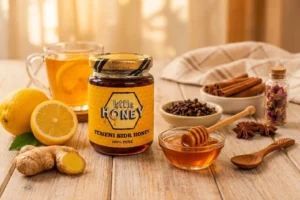
Wondering how to tell if your honey is pure? Start with the label, ingredients, and stated origin rather than relying on color or texture alone. These details can give you a better idea of what you’re buying and where the honey comes from.
If you’re looking for Little Honey Straws in Singapore, knowing how to check honey quality can also help you make a more informed choice. You may have seen water, flame, or thumb tests online. But these simple tricks can’t confirm whether honey is pure. In this guide, we’ll look at practical checks that are more useful, from sourcing and processing details to laboratory testing when stronger evidence is needed.
What Does Pure Honey Actually Mean?
Pure honey means the product is honey without undeclared sweeteners or other ingredients added to change its composition. That’s the basic idea. But the word “pure” on a label isn’t proof by itself.
Honey can be mixed with cheaper syrups, which is one form of honey adulteration. The U.S. Food and Drug Administration has specifically tested honey for undeclared sweeteners, including syrups made from corn and cane sugar. That doesn’t mean every jar is suspect. It means buyers have a good reason to look beyond color and texture. So, when checking a jar, ask a better question: Can the seller explain where this honey came from and what happened to it before packaging?
Start With the Ingredient List
This is the easiest check, and people often skip it. Look at the ingredient panel before judging the honey by its color. If the product is sold as honey, the ingredient information should make it clear whether anything else has been added. Watch for wording that turns a simple honey product into a blend. Added syrups, flavorings, or other sweeteners change what you’re buying.
A short ingredient list is useful, and honey authenticity depends on more than a neat label. A label can tell you what a producer claims. It doesn’t independently verify the claim.
That’s why the next checks matter.
Check the Stated Origin
Good honey has a story that makes sense. Look for a stated country or region of origin. If the product is a single-origin honey, the seller should be able to explain that claim clearly. If it’s a blend, that should also be clear.
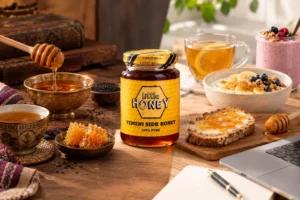
For Sidr honey, origin matters because the honey’s character can vary with the growing region, season, and floral source. Little Honey Straws currently presents Yemeni Sidr and Kashmiri Sidr among its honey offerings, with sourcing information provided on its website. Don’t treat a fancy origin story as automatic proof, though. Ask whether the seller provides enough detail to support it.
Can You Test Honey at Home?
This is where many online tips go wrong. People searching how to tell if your honey is pure often find the same viral tests. You’ve probably seen the water test. Or the flame test, the thumb test, even advice about whether honey sinks fast. These tricks are easy to demonstrate. But they’re not reliable proof of authenticity.
Honey naturally varies in moisture, viscosity, and temperature. Those differences change how it behaves in water or on a surface. A thick honey just acts differently from a runny one; neither is automatically fake. The same problem applies to crystallization. Different honeys crystallize at different speeds. Some stay liquid longer than others. So don’t toss a jar because it crystallized. And don’t trust one just because it stayed liquid.
Quick Myth Check
| Popular Test |
What People Claim |
What It Actually Tells You |
| Water test |
Pure honey sinks or stays together |
Shows how the sample behaves in water, nothing more |
| Flame test |
Pure honey burns differently |
Not a reliable home authenticity test |
| Thumb test |
Pure honey stays in place |
Texture and viscosity vary naturally |
| Crystallization |
Crystals prove real honey |
Crystallization is natural and varies by honey |
| Color check |
Darker honey means purer honey |
Color depends on floral source, not purity |
Look at Texture, Aroma, and Taste
Your senses still matter. Just don’t ask them to do a laboratory’s job. Real honey can be thick, thin, floral, earthy, mild, dark, pale, smooth, or partly crystallized. There isn’t one universal look that every authentic honey must have. Taste can be especially useful when you’re comparing products from the same type of honey. You may notice differences in sweetness, aroma, finish, or texture.
For Sidr honey, a rich aroma and distinctive flavor can be part of the experience. But those characteristics shouldn’t be treated as scientific proof of purity. Think of sensory checks as quality clues. They’re useful for noticing something unusual. They aren’t a certificate of authenticity.
Read the Processing Information
Processing can affect what you see and taste. Some honey is filtered heavily. Some is minimally filtered. Some products are heated during processing. Others are handled more gently. If you’re buying honey because you want a less processed product, raw honey may be what you prefer. Look for clear information about how it’s handled. Don’t assume “raw” automatically means authentic, either. Raw describes processing, while authenticity asks a different question.
This distinction matters. A product can be minimally processed and still require verification of its origin or composition. And the reverse can also be true. Processing doesn’t automatically mean a honey product contains added syrup.
The useful approach is to separate these questions:
- Is it actually honey?
- Has anything been added?
- Where did it come from?
- How was it processed?
- Can the seller support those claims?
Check the Seller Before You Check the Spoon
This is one of the most practical habits you can build. Look for a business that gives specific product information rather than vague promises. Check the stated origin, ingredients, product size, processing details, and contact information. A seller who openly explains sourcing gives you more to work with than one who only uses words like “premium” or “100% natural.”
Little Honey Straws focuses on Sidr honey from Yemen and Kashmir and sells honey in both jars and straw formats. Its website also provides product and sourcing information for its honey range. That’s the kind of information worth checking before you buy. In my experience, shoppers often spend five minutes comparing honey color but barely thirty seconds reading the product page. Flip that habit. The product details usually tell you more.
When Laboratory Testing Makes Sense
If you need stronger evidence, laboratory testing is more reliable than home tests. Labs can examine things such as sugar profiles, stable isotope ratios, moisture, pollen, and other characteristics to look for signs of adulteration. Different tests detect different problems, so there isn’t one test that proves everything.
For premium honey, testing and traceability can give buyers more confidence. You can also ask the seller about sourcing, batch information, or any available laboratory results before making a purchase.
What Should You Look For Before Buying?
You don’t need a detective kit.
Start with the basics:
- Check the ingredient information.
- Look for a clear origin.
- Read the producer’s sourcing details.
- Check how the honey was processed.
- Look for batch or traceability information when available.
- Be cautious with dramatic purity claims that have no supporting detail.
- Treat home tests as curiosity, not proof.
- Ask about laboratory testing when authenticity really matters.
These checks work especially well when buying higher-value varieties. If a seller is asking you to pay more for a specific origin, the sourcing story should be clear.
What About Sidr Honey?
Sidr honey deserves the same basic scrutiny as any other premium honey. You may see Yemeni Sidr, Kashmiri Sidr, or other regional varieties marketed around origin and flavor. Those differences can matter to buyers, but a name alone doesn’t prove authenticity.
At Little Honey Straws, the focus is on Sidr honey sourced from Yemen and Kashmir. The range includes Yemeni Sidr Honey and Kashmiri Sidr Honey, along with convenient straw options. If you’re choosing Sidr, compare the product information first. Then consider taste, texture, format, and price. Don’t let a dramatic “purity test” on social media make the decision for you.
The Biggest Mistake Buyers Make
The biggest mistake is looking for one magic sign. If you’re still wondering how to tell if your honey is pure, look at the full evidence instead. There isn’t. Pure honey doesn’t have to pass a flame test. It doesn’t have to stay liquid. It doesn’t have to be extremely dark. It doesn’t have to behave one particular way in water.
What matters more is the complete picture: ingredients, origin, sourcing, processing, seller transparency, and testing where appropriate. That’s a much more useful way to think about honey quality.
Conclusion
How to tell if your honey is pure isn’t really a kitchen question. It’s a sourcing question. Water tests, flame tests, and thumb tests may be interesting experiments, but they don’t provide real proof of purity.
Real confidence comes from knowing where your honey was harvested, how it was processed, and whether the brand behind it is willing to share that information openly. Explore the Sidr Honey collection at Little Honey Straws and learn more about the honey’s origin, varieties, and everyday formats.
FAQs
- Can you tell if honey is pure by looking at it?
No. Color, thickness, and clarity vary naturally among honeys. They can’t confirm authenticity on their own.
- Does crystallized honey mean it’s fake?
No. Crystallization is a natural process. Different honey varieties crystallize at different rates.
- Does the water test prove honey is pure?
No. The way honey behaves in water depends on factors such as moisture, temperature, and viscosity. It isn’t a reliable authenticity test.
- What is the most reliable way to test honey purity?
Laboratory analysis is more reliable than home tests. Different methods can detect different types of adulteration, so no single test covers everything.
- What should I check before buying premium honey?
Check the ingredients, origin, sourcing information, processing details, seller transparency, and any available traceability or laboratory evidence.