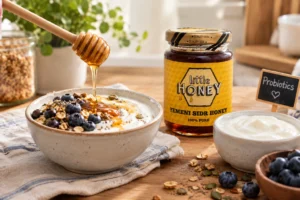
Yoghurt with a drizzle of honey is one of those combinations that feel like they should be good for you, and it turns out there’s some genuine reasoning behind that instinct. Honey and probiotics are increasingly paired together in gut health conversations, though understanding exactly why requires looking past the marketing and into what’s actually happening when the two meet.
If you’ve ever wondered whether this pairing is more than just a tasty breakfast habit, this is worth exploring properly. At Little Honey Straws in Singapore, we get asked about this combination often, so let’s break down what’s actually going on.
What Are Probiotics, Quickly Explained
Probiotics are live microorganisms, often bacteria, that are commonly associated with gut health when consumed in adequate amounts. You’ll find them naturally in fermented foods like yoghurt, kefir, sauerkraut, and kimchi, or in supplement form.
The idea behind probiotics is that they may help support the balance of bacteria already living in your gut. This is a genuinely active area of ongoing research, and their effects can vary depending on the specific strain and the person consuming them. Not every probiotic strain behaves the same way, so research findings for one strain don’t automatically apply to every product labeled “probiotic” on a shelf.
Where Honey Fits Into the Picture
Honey doesn’t contain probiotics itself; it’s not a fermented food and doesn’t carry live bacterial cultures the way yoghurt or kefir do. Honey contains sugars and other naturally occurring compounds that have been investigated for their potential effects on gut microorganisms. Some research suggests certain honeys may have prebiotic-like effects, but this doesn’t mean honey is a clinically established prebiotic.
This distinction matters. The two ingredients work through different mechanisms. Honey isn’t adding bacteria to your gut; it may simply be creating conditions that are somewhat more favorable for bacteria that are already there or introduced through other foods.
Is Honey a Prebiotic or a Probiotic?
These two terms often get mixed up, but they mean different things. A probiotic contains live microorganisms; honey doesn’t have this, so it isn’t a probiotic. A prebiotic, on the other hand, is something that may help feed or support bacteria already in your gut.
Honey hasn’t been established as a clinically recognized prebiotic, but some of its naturally occurring compounds have been studied for prebiotic-like effects. So while it’s not accurate to simply say “honey is a prebiotic,” it’s fair to say honey may share some characteristics with prebiotic foods, without making it one in a strict, established sense.
Does Honey Actually Help Probiotics
This is where the science gets more nuanced than a lot of casual health content suggests. Some laboratory studies have looked at whether honey can support the survival of probiotic bacteria as they pass through the digestive system, with certain studies suggesting a possible supportive effect in controlled settings.
That said, laboratory findings don’t always translate directly to what happens in an actual human gut, and more research is generally needed before strong claims can be made. It’s reasonable to say this pairing may work well together as part of a varied diet, without overstating honey as some kind of probiotic enhancer with guaranteed effects.
Comparing Honey to Probiotic Foods
Here’s a simple way to think about what each part of this pairing may offer on its own.
| Element |
What It May Offer |
What It Doesn’t Do |
| Probiotic foods (yoghurt, kefir) |
Live bacterial cultures |
It doesn’t provide honey’s natural compounds |
| Honey |
Natural sugars, trace antioxidants |
It doesn’t contain live bacteria itself |
| Together |
A combined food pairing that some people enjoy as part of a balanced diet |
Not a guaranteed gut health treatment |
Neither honey nor probiotic foods should be treated as a stand-alone fix for digestive issues. They’re best understood as parts of a broader, varied diet rather than a specific remedy.
Best Ways to Combine Honey and Probiotics
If you want to try this pairing yourself, here are some simple, everyday ways to do it.
- Stir a spoonful of honey into plain, unsweetened yoghurt
- Add honey to kefir for a milder, more approachable flavor
- Drizzle honey over fermented foods like a fruit-based chutney
- Mix honey into a smoothie that includes a probiotic yoghurt base
- Use honey as a natural sweetener alongside probiotic supplements taken with food, if recommended by a healthcare provider
Keeping portions reasonable matters here too; honey is still a sugar, so using it as an accent rather than pouring it liberally keeps this pairing balanced. A teaspoon or two stirred through a bowl of yoghurt is usually plenty to add flavor without overwhelming the dish or your daily sugar intake.
Can Honey and Probiotics Be Taken Together?
For most people, honey and probiotic foods can be enjoyed together as part of a normal diet. Mixing a small amount of honey into cold yoghurt or adding it to a smoothie doesn’t turn honey into a probiotic, but it can make fermented foods more enjoyable and easier to include regularly.
If you’re using a probiotic supplement, follow the product’s storage and usage instructions rather than assuming honey will improve its effectiveness. Different probiotic strains and products can have different requirements.
What the Research Actually Says
It’s worth being direct about where the science currently stands. Some studies, often smaller or laboratory-based, have explored honey’s potential prebiotic-like properties and its effect on probiotic bacteria survival. The findings are interesting and worth paying attention to, but they aren’t yet conclusive enough to describe honey as a proven method for boosting probiotic effectiveness in the human gut.
This is genuinely an evolving area of nutrition science. Rather than treating this pairing as an established health hack, it’s more accurate to see it as a reasonably supported, food-based combination that fits well into a varied, balanced diet, without needing to oversell what either ingredient does on its own.
This Pairing at a Glance
| Question |
Short Answer |
| Does honey contain probiotics? |
No, honey doesn’t contain live bacterial cultures |
| Does honey support probiotic bacteria? |
Some studies suggest a possible supportive effect, though more research is needed. |
| Can I mix honey with yoghurt? |
Yes, this is a common and safe combination |
| Does raw honey work better than processed honey here? |
Raw honey retains more natural compounds, though specific effects on probiotics aren’t fully established. |
| Is this pairing a treatment for digestive issues? |
No, it’s best viewed as part of a varied diet, not a treatment |
Common Misunderstandings About This Pairing
A few ideas tend to circulate about this pairing that are worth addressing directly.
- Honey is a probiotic: This isn’t accurate. Honey doesn’t contain live bacteria, so it isn’t a probiotic itself. It may have prebiotic-like properties in some contexts, which is a different concept entirely.
- Adding honey to yoghurt destroys the probiotics: There’s no strong evidence supporting this for normal serving temperatures. Heat can affect live cultures, but stirring room-temperature honey into cold yoghurt isn’t the same as cooking it.
- More honey means more benefit: Honey is still a sugar source, and using large amounts doesn’t translate to a proportionally larger benefit. Moderate amounts fit better into a balanced approach.
Why the Type of Honey You Use Matters
Not all honey is processed the same way, and this can affect what naturally occurring compounds remain in the final product.
Processed vs Raw Honey
Heavily processed honey, filtered and heated extensively, tends to retain fewer of its naturally occurring compounds compared to raw, minimally processed honey, though specific effects on probiotics aren’t fully established. If you’re curious about this distinction in more depth, our guide on raw vs processed honey covers it further.
Our Sidr Honey
At Little Honey Straws, our Sidr honey varieties are sourced from identified producing regions, including Yemen, Kashmir, and KPK in Pakistan. It works well stirred into yoghurt or other probiotic foods as part of a varied diet, though it shouldn’t be considered a treatment for any digestive condition. For more on how honey fits into digestive wellness generally, our guide on honey for digestive comfort is worth a read too.
Choosing honey with clear sourcing information also means you’re better informed about what you’re actually adding to your yoghurt or smoothie each morning, rather than guessing based on a generic label.
Where to Get Pure Sidr Honey in Singapore
If you’re building a habit around pairing honey with probiotic foods, checking the ingredient list, stated origin, and processing information can help you choose honey that matches your preferences.
Little Honey Straws sources Sidr honey directly, with clear information about where each variety comes from, whether that’s Yemen, Kashmir, or the KPK region of Pakistan. We deliver across Singapore, making it easy to keep well-sourced honey on hand for your morning yoghurt or any other use.
Whether you’re stirring it into breakfast or experimenting with your own combinations, having honey you genuinely trust the source of makes this kind of everyday habit feel worthwhile.
Final Thoughts
Honey and probiotics make a genuinely pleasant pairing, and there’s reasonable, if still developing, evidence that honey may offer some supportive qualities alongside probiotic foods. That said, neither should be treated as a cure or guaranteed fix for digestive health; they work best as part of a broader, balanced diet.
If you want honey worth adding to your probiotic-friendly breakfast, Little Honey Straws offers pure Sidr honey right here in Singapore. Contact us or call us at +65 8651 2712; we’re happy to help.
FAQs
- Does honey contain probiotics?
No, honey doesn’t contain live bacterial cultures, so it isn’t a probiotic food itself.
- Can honey support probiotic bacteria in the gut?
Some studies suggest honey may have prebiotic-like properties that could support certain bacteria, though more research is needed to draw firm conclusions.
- Is it safe to mix honey with yoghurt?
Yes, this is a common, safe combination that many people enjoy as part of a balanced diet.
- Does heat destroy the benefits of honey and probiotics together?
Stirring room-temperature honey into cold yoghurt is unlikely to significantly affect either. Cooking or heating probiotic foods, however, can reduce live cultures.
- Should I take probiotic supplements with honey?
This depends on the specific supplement and your individual health needs. It’s worth checking with a healthcare provider for guidance specific to your situation.